With the exception of a reviewer that I trust, I seldom read book reviews. I say this knowing that I have a book review coming up in the near future. Well, let me correct myself. I seldom read book reviews before I read a book. I quite like reading them afterwards. I like seeing how other people feel about the book and comparing and contrasting my own feelings. It will sometimes help me to understand why I liked or disliked aspects of the book or may point out easter eggs that I missed. So, having read a lot of reviews after the fact, I have developed a sense for which reviews are going to acurately describe the book.
As Amazon is the largest collection of book reviews, I will use them as the review reading platform.
1. Skip the plot summaries- They are full of spoilers and aren't really reviews. I don't really care to have the book condenced to 600 words by somone.
2. Look at the one star reviews first. Some books have a political message that others don't like and that you may not like. These are always revealed in the one star reviews. Sometimes the one star reviews attack the book because of the writer's view points or other works and are not based on the current work. A good percentage of one star reviewers didn't attempt to read the book.
3. Avoid the 5 star reviews*. Every genre and every writer has fanboys. No wrong can be done in their eyes. These reviews are usually all praise and will not point out shortcommings.
4. Read every 3 star review. These are the best. They generally can see both the good and the bad and express them well. They are not biased towards the book in any way or will admit their bias and explain how they overcame it. The 3 stars are the most informative reviews.
*5 star reviews can be helpful if the tally is very top heavy, but then 4 star reviews usually take the place of the 5 stars.
I hope that anyone that reads reviews before reading get some help from this list. I also hope that the reviews I write provide the information that I praise three star reviews on Amazon for containing.
If you have a sci-fi book you would like reviewed, drop me a comment. I will review it if I have read it.
Showing posts sorted by relevance for query book review. Sort by date Show all posts
Monday, August 30, 2010
Tuesday, September 28, 2010
Book Review: "Kraken" by China Mieville
When I finished the audiobook of China Mieville’s new novel “Kraken”, the first thing that went through my mind was was that it’s not too often that you come to the end of a book and think “I’ve never quite read anything like that before” – and it’s wonderful to realize that authors can still surprise and delight you.
Now I’m sure we can all agree that giant squids are awesome. And I have always been fascinated by them. Why? Because they might be the last “monster” left on earth. Smart, powerful, dangerous and “other” -- they’re not like you and me, these invertebrate behemoths of the deep. So when this book popped up on some “if you liked that, you might like this...” algorithm, I knew that I had to give it a try.

Billy Harrow is a curator at London’s Natural History Museum and one day finds that his prize specimen -- a recently collected giant squid, indeed its entire tank full of preserving fluid -- has been stolen. Who steals a giant squid and moreover how? These questions lead Billy into a world hidden within our own -- one of magic, power, strange religions, its own police unit, and dangerous politics. After the theft, things go from bad to worse, as it becomes alarmingly clear that the theft of the squid is central to an onrushing Apocalypse that threatens to wipe out all things. The ensuing story is thoughtful, funny, scary, thrilling , and at times, oddly touching -- maybe the most bizarre whodunit I’ve ever read.
I’m sure that Mieville’s book will be compared to Neil Gaiman’s “Neverwhere” -- another novel that explores a world-within-a-world in London, but the book reminds me more of Neal Stephenson’s “Anathem”. What makes this book so good to me is that like Stephenson, Mieville creates an incredibly realized world like nothing we’ve really seen and makes you believe in it and the fantastical characters that reside in it. Mieville’s story has maybe a half-a-dozen ideas that are clever and powerful enough to power their own novels outright, but here are brought into service of this one.
The other thing that made this book an absolute joy to listen to was Mieville’s use of language. He wielded grammar and vocabulary so deftly that it made me feel like English was my second language. So much so, that in an unprecedented move, I am actually buying the physical book so that I can go back and re-read it sometime.
I don't believe in book-review grade-inflation, but easily five stars out of five.
Labels:
book review,
books,
china mieville,
fantasy,
giant squid,
horror,
kraken
Thursday, August 12, 2010
Little Brother Book Review
Pretentious much, Cory Doctorow? I man the book oozes pretention. The protagonist is the coolest, most justified, smart and always right person ever. The bad guys are one dimensional and are all uniform carbon copies of each other. They are uncool, unjustified in any action, and always wrong and stupid. Wait the bad guys are all racist, homophobic, and republican. Wait, the bad guys aren't republican, Republicans are the bad guys. There is a difference there and Doctorow preaches it to you.
I actually liked the book at the beginning. It was interesting if a little unplausible. The premise is that a bomb blows up the Bay Bridge and Bart tunnel. Four friends, cutting class to play an ARG (alternate reality game) are caught in the thick of it and get hauled in by Homeland Security as suspects. After their secret detention and humiliation, all the kids cooperate and are released except one that had been stabbed in the chaos after the explosion. The protagonist vows revenge for his humiliation.
Labels:
book review,
books,
corey doctrow,
homeland security,
little brother,
rfid,
security,
waterboarding
Tuesday, November 27, 2012
Abraham Lincoln: Vampire Hunter (2012)
I must preface this review with the statement that I have read and enjoyed the book that Abraham Lincoln: Vampire Hunter was based on. My Review Here, Steve's review here.
Disappointed. That is how I feel; disappointed. I mean. I told everyone how great the book was and how factual it was. I think I have said that the book is 90% biography and 10% vampires. I stick by that for the book. A lot of poeple I said this to, will not read the book, but they will watch the movie. What will they think of me after that.
The acting was good. I saw it mentioned that the guy playine Lincoln looked a lot like Liam Neeson, my wife mentioned it as well. Alan Tudyk was Stephen Douglas which was a pleasant surprise.
The plot was similar to that of the book except that it wasn't any good. They turned this into an action movie. Actually it was more of a superhero movie with Lincoln having super human strength and agility. According to the movie, Lincoln only had one child who was murdered by vampires. In reality, Lincoln had 4 sons, two of which died before Lincoln himself (vampires?). The other two sons outlived Lincoln, but only one made it to adulthood (vampires?). The book gets this right.
The beauty of the book is that it did not try and shoe horn vampires into the story. It took tragic events in Lincolns life and attributed them to vampires. It takes those empty periods when Lincoln wasn't making history and attributed those times to vampires. The movie fails in this respect. Maybe there wasn't enough time to tell the Lincoln story and the vampire story, but only telling half makes the movie lose its charm.
Overall- It is an action movie. It is not as good as the book. I would say 10 and up due to action violence.
Labels:
2012,
abraham lincoln,
also a book,
vampire,
vampire hunter
Tuesday, August 03, 2010
Book Review: "Abraham Lincoln, Vampire Hunter" by Seth Grahame-Smith
In the brief author interview that follows the conclusion of “Abraham Lincoln: Vampire Hunter”, Seth Grahame-Smith relates that he got the idea for this book by going into bookstores in 2008. At that time, historians were gearing up to commemorate the bicentennial of Lincoln’s birth and of course there was “Twilight” fever. Everywhere he looked were books about Lincoln and books about vampires. Lincoln and vampires... Lincoln… vampires… – hey, I got an idea!
Now, I’m usually not one for “gimmick” books and I have not read Grahame-Smith’s “Pride and Prejudice and Zombies”, which I know spawned a torrent of similar classics-into-horror knock-offs. But after Budd’s positive review the other month, I had this book in the back of my mind when I was thinking about downloading an audiobook to listen to during my daily commute.
I have to say that this book was a lot of fun. The premise is pretty clearly spelled out in its title and the fun conceit of it that Lincoln – probably the American with the most studied and examined life in history – had a secret life as a vampire hunter (vampires in America were enjoying a bit of a heyday in the first half of the 19th century as it turns out).
Primarily, the book reads (what verb do you use here for an audiobook? “The book is presented?” anyway…) as a biography derived from Lincoln’s heretofore unknown private journal. With surprising depth and cleverness, Grahame-Smith interweaves the vampire yarn into the fabric of Lincoln’s life (and American history) – from his youth, through his adulthood and even to his Presidency and the Civil War. In fact, most of the book could be described as non-fiction, which is a weird thing to say. Real people, real events are all re-interpreted and re-presented. I couldn’t help but smile at the ingenuity of it all. It’s not all played for wry smiles though; there are definitely some parts in there that give a few chills and are not for the squeamish. And somewhere in there, I started to really like this Lincoln. I was rooting for him, even though you sort of know how it’s going to turn out on April 14-15, 1865.
Yes, this book is a lark, and I’m really not going to line up to read (or listen to) all the knock-offs, but if you want to take a stab at this mini-genre, this one is pretty fun.
Thursday, July 28, 2011
The Magicians-book review
Lev Grossman's The Magicians came to me as a highly recommended "gritty Harry Potter." Some even called it, "what if Harry Potter went to college." So, I was very intrigued and couldn't wait to start reading it.
Plot- Quentin and his friends are the smartest kids in NYC and are all going to Princeton, but what is the point, until Quentin is whisked away to a magical college. He takes an interesting exam and then the author rushes him through 5 years of college where he and his friends are the smartest kids at school and are all also edgy alcoholics, but what is the point and life sucks. He graduates and is able to live off of a magical trust fund and he and his friends all become drug addicted drunks, life is so boring until a long lost enemy comes to him with the key to a Narnia like world from books that all, and I mean all, the characters have read and worship. They all go to the Narnia like world and Quentin is, amazingly, still not happy. At one point he opines that he wished he would have brought some drugs with him because that would make the lame Narnia world really cool. He proceeds to get drunk in Narnia world. It goes on from there, I don't want to spoil it for you. It has a lot of cussing and sex in it too.
Characters- There is really one likeable character in the whole book and she surrounds herself with so many unlikeable characters that you end up hating her for it (oh, she is a complete Hermione clone). I take that back, Josh seems cool to but is so underdeveloped that you just don't know, and he also surrounds himself with douches. Quentin is the lead and he is an ever whining, perfect at everything, never happy, BORE. He is exactly the type of person that you try and not make friends with but he always comes over and talks to you and you can't escape. Usually the protagonist of the novel changes and grows during a novel, especially one that cover 5 years in 402 pages. Confederacy of Dunces is proof that you can have a totally unlikeable character and still have a good book that engages the audience. This book fails to do that.
Overall- The book started well and there were parts in the middle and end that worked, but if you couldn't tell by now, I didn't like it. I think Grossman had an excellent idea that fell apart in execution. The writing felt rushed. It felt like Grossman would just get bored with writing parts and would just move on to his next ideas. The book was full of "oh yeah" moments. These are where the auther would have an event or action and then have to go back and explain why a character knew some information or that someone had come in to a room, things like that.
There is one piece of completely hideous writing that I would like to paraphrase here. The characters are all tired and weary from this battle and they are at the boss, they are in fear of their own and their friends lives, earlier in the novel they had demon gnome things tattooed into their backs that they would fight for them once upon being released. The protag, in a state of fear and exhaustion, in the middle of a battle turns around, lifts his shirt, says the incantation to let the demon out and then says, "Say elloh to my little friend!" No kidding.
I didn't like it, but some people did, I guess. People call it edgy, but in my book it takes more than sex, drugs, and cussing to be edgy. You can't compare this to Harry Potter or Narnia, but the book brings these two worlds up so much as to draw constant comparison to something better. To me it felt like what would happen if Grant Morrison were to pen a novel.
Labels:
book review,
confederacy of dunces.,
harry potter,
magicians,
narnia
Monday, August 23, 2010
Suck it Wonder Woman- Book Review
The only real reason to do a memoir is to name names and tell people about your life. She names Evander Holyfield, but you are left to speculate who she is referring to in the other antecdotes. She doesn't really give you much about her life except a great chapter in the middle of the book where she talks about her Grandmother's death.
I don't think she had a ghost writer. She had a co writer, but I don't know how much he did. If he did a lot he isn't very good. Maybe he did that one chapter that was really good. I think this was just her writing stuff that she thought was going to be fun. It is very conversational. There are filler pages that consist of Tweets of Princess Leia and Olivia's romantic advice. These felt out of place in the book and seem to come up at random.
As a casual fan of Olivia Munn, this book didn't satisfy me. I was less interested in her trying to be funny and more interested learning about her life. I know a little more than I did before, but I got that off of wikipedia. The book just wasn't satisfying. I am positive that she is smarter than she plays on TV, but this book didn't show me that.
While some of it was entertaining the book kind of fell flat. I could have done with a lot less of her talking about how she isn't hot or skinny or how she doesn't fit the Hollywood mold. She does. I would give this book a 3 and it isn't for kids to language and adult situations and humor.
Related articles by Zemanta
- Munn Defends Wonder Woman (foxnews.com)
- Olivia Munn takes on 'Chuck' (hollywoodnews.com)
- Olivia Munn Continues World Conquest, Will Guest Star on 'Chuck' (tvsquad.com)
- Audioslice: Olivia Munn's Suck It, Wonder Woman! (tor.com)
Tuesday, September 17, 2013
The Historian's Tale -Book Review
The Historian's Tale by K.B. ShawMy rating: 3 of 5 stars
I received the book as a review copy. I am usually skeptical of self published works, but I have read an earlier novel of Shaw's as well as the short story that he expanded this novel into. So I knew he was capable of delivering a good story and he didn't let me down here. He does a pretty good job of creating this society with its strange rules. He shows some world building skill in the part of the book where they explore the basin, and I imagine/hope that would be further developed later in the series. There are a few weeknesses of this book. The middle part slows down as the characters discover and try to understand the technology that they have found. Not sure how you liven that section up, though. I would have also liked a bit more explanation from the chancilor. I understand the implementation of the sex scenes to differentiate Neworld culture from Earth culture, but it did seem a bit gratuitous, especially for a YA book.
Overall, I enjoyed the book. I would love to see the solar map in a future book that shows the binary star and the planet's orbit around them and how it effects the cycles, but I realize, I may be in the minority on that part. It was a quick read, which was a welcome respite after a few of the more recent books that I have read (looking at you 2312 and Consider Phlebas). I would catagorize it more as teen than YA with a 14+ age range.
View all my reviews
Monday, April 04, 2011
Cell Spoiler Free Book Review-A to Z Challenge

Plot- This is a survivor's tale. I am unsure why survivors feel the need to travel, I mean for one character it is obvious why he wants to walk across two states, but the others made me wonder. The story borrows from The Stand somewhat, which is okay because The Stand was an excellent book and very well done. The Stand was better though. Not sure that the book has aged well. Cell phones are so different now then they were upon the writing of this book. The story does start off lightening fast and then slows down into a strolling past and then kind of rushes to the finish. Of course the ending will leave you guessing.
Characters- There is a comic book writer/illustrator, a religion hating gay guy, and a teenage girl that knows about Neal Stephenson (I strongly doubt that this is possible). Not completely stereotypical yet they completely are. We don't really get to know the characters all that well. This story is plot driven and we get reactions of the characters but no real characterization. In other words, you won't feel connected to these characters.
Overall- It was entertaining. I have read better King and I have read better survivor tales, I have read better King survivor tales. It isn't bad. This book was about the idea and I get that, but I wish he would have fleshed it out a bit more. It may have added a couple of hundred more pages, but it would have been a better book. Kingophiles will have read this arlready, but for everyone else I say you aren't missing anything by passing it up, but it is somewhat entertaining.
Labels:
horror,
stephen king,
zombies
Friday, December 17, 2010
Trillian's Read My Review
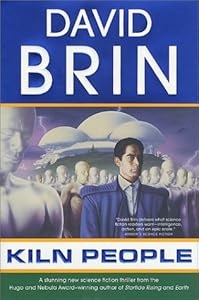
Cover of Kiln People (The Kiln Books)
Trillian is hosting a science fiction book review type blogfest. The great thing is that you can use a review that you have written before as long as it fits the criteria. I could use pretty much any review on this site but I will pick my Kiln People review. I picked it because it was pretty good and I don't think it is on a lot of people's radar.
Please click the button above to read other scifi book reviews that you may be interested in.
Labels:
blogfes,
david brin,
kiln people
Tuesday, August 11, 2009
Anathem
world that is very complicated, has its own history, and creates a
language to go along with it. While some elements of the novel will be
very similar to what the reader is used to, some of the book can be very
confusing.
The story follows Erasamas, a young avout, as he is pulled out of his
math (a scientific monastery of sorts) with several of his companions to
solve a problem of the secular world. The beginning of the book is set
up to explain to you what a math is like before you get to the actual
plot. The pacing can be slow at times but lightening quick at others.
This is a very aggressive work by Stephenson and may be called his
masterpiece. Not that it is perfect, but Stephenson set out to write a
literary science fiction novel and he succeeded.
Readers of Stephenson know that he has a tendency to not end a book so
much as he stops writing it. In this book Stephenson did a good job of
wrapping things up on some degree and leaving a lot up to the
imaginations of his readers. A goal that he has been tweaking from day
one.
This book is hard to suggest to just anyone. People with very
scientific minds that love talking about and exploring theories and
science should really get into this book. The literary elite have
seemed to enjoy this book as well. This book is very deep and thought
provoking though. This isn't popular sci-fi. Personally, I loved it.
Monday, September 24, 2012
Among Others- Book Review

Among Others, by Jo Walton, is a hard book to describe. I guess the easiest way is to say that it is the winner of both the Nebula and the Hugo awards. I don't know if it is deserving of the award as I have not read the other nominees as of this writing. It is very interesting and it is in a diary type format, but I think the best way to describe it is as a coming of age story...for girls. It has fairies and boys and father issues; yep, definitely a coming of age story for girls.
Plot- We meet young Mor on an adventure with her twin and then we are transported to a future where Mor is alone and her sister is dead. Mor is leaving the Magical Welsh countryside and is stuck in a very unmagical boarding school. It is kind of like Harry Potter in reverse. Along the way we get to hear about all the wonderful science fiction and fantasy books that she is reading, some(most) of which, we still haven't read.
Characters- I don't know how much to say here as I don't want to ruin anyone elses raw interpretation of the book. Finish the book and then email me and we can talk about Mor. Mor is really the only developed character. Mor sees the other characters as fulfilling roles and they aren't established beyond these roles, this works as the book is a diary.
Overall- The book left me conflicted. It has some action I guess, but that is always secondary. It is more of an exploration of Mor and her coming of age story. Thankfully the writing is good and it is very easy to be consumed into Mor's world. I should have known it wasn't going to be a normal story as the narrator tells someone along the way that he is looking at things as if they were a story and that stuff doesn't happen in real life. I was not, however, satisfied with the ending.
I am not sure who to recommend this book to. I am letting my 11 year old read it, knowing that there are some adult situations in the book and talk of sex, pregnancy, abortion, incest, and homosexuality. She knows about all these things, but they are presented a bit differently in this book than what she may be used to and that we may discuss afterwards. it was good, but I don't know if it was great.
Labels:
among others,
book review,
budd,
fairies,
fantasy,
hugo,
jo walton,
nebula
Wednesday, April 21, 2010
In the Country of the Blind
Michael Flynn
Tor Science Fiction, 2003
ISBN-10: 076534498X
ISBN-13: 978-0765344984
Let me start my review by stating that the cover of this book does not portray the contents; sorry.
I believe this book was Michael Flynn's first novel. I have read some of his Firestar Novels and enjoyed them. He seems to like the ensamble cast with multiple plot lines that diverge and all lead back. I do to. He also likes to write about strong female characters.
This book is about the study of Cliology. Think Asimov's Foundation psychohistory, or a direct translation, the science of history. In this book, an algarithim is discovered by Charles Babbage that will allow the prediction of the future. A secrtet society is formed around this secret.
Monday, July 25, 2011
Book Review: "A Discovery of Witches" by Deborah Harkness
One thing I’ve noticed since I’ve begun following book bloggers and keeping up with friends on Goodreads is that the quality of book I’ve been reading has been getting better. Surely, this is because most of the books I start now have been reviewed by someone whose tastes I understand might be similar to mine.
So, it’s a bit of a cautionary tale that I began listening to the audiobook of Deborah Harkness’ A Discovery of Witches, which I found by scanning Audible.com’s “Most Popular” list, forgetting perhaps that in a world of chart-busters such as Stephanie Meyer and Dan Brown that “the people” tend to sometimes get into books that aren’t, well, let’s just say, in my sweet spot.
A Discovery of Witches follows the adventures of Diana Bishop, who has eschewed her heritage as a witch in lieu of making it on her own as an academic historian. While on sabbatical at Oxford, she becomes embroiled in subterfuge concerning a mysterious manuscript that just might hold the key to the nature of witches, vampires and daemons. Initially, she wants nothing of it, but becomes intrigued by and then enamored of a vampire, Matthew Clairmont, who for some reason seems to be looking out for her, as well as the book.
When I started all the bones of a great story seemed to be there: witches, vampires, daemons, biology, alchemy, and history. It seemed as though Harkness wanted to upgrade the Twilightian fantasy by taking the particulars out of high school and make them adults (both in age and in outlook).
Sadly, the story just didn’t hold up for me. Matthew, naturally (or perhaps supernaturally) is supposed to come across as incredibly smart, and incredibly brave, and incredibly handsome, and incredibly strong, and incredibly fast, and incredibly learned on all subjects, and incredibly dangerous and don’t forget incredibly sensitive. What happens is that he becomes incredibly annoying, while Diana gets trapped in the unwilling-but-plucky heroine clichés that make their scenes together – especially after falling for one another – downright painful.

There were two parts during my listening that really shaped my view. One came about two-thirds of the way through during probably the best and most tense scenes in the book. I’d been sort of slogging along and was hoping for something to shake things up and it began to seem like it might be coming together. As I was listening to the climax, I realized that one of two outcomes was most likely: a cliché’ one that you could see coming from a mile away or a courageous one that could really have set the novel in a new and interesting direction. Guess which one Harkness chose? Yeah.
The other moment was as the book was winding down – about 13 hours into the 14 hour total – that my stomach sank as I realized that THIS BOOK IS NOT A STAND-ALONE STORY!
I should have known. Isn’t anything that can possibly be labeled as “paranormal” – especially “paranormal romance” – required to come in multiple parts? Of course it is. Naive Stevil.
Anyway, in the end, I think Harkness has tried to write a romantic, paranormal, action adventure – and it was certainly a book I wanted to like more than I did. Oddly enough, in some ways it’s a cross between Twilight and The DaVinci Code. So, if you’re into either one or both of those, give A Discovery of Witches a try.
If not, listen to your friend and give this one a pass.
Two stars out of five
Labels:
a discovery of witches,
book review,
books,
daemons,
deborah harkness,
paranormal,
vampires,
witches
Wednesday, June 09, 2010
Ubik
Need to write a book review? Ubik can help. One tablespoon of Ubik before you start will get the words rolling right off of your tongue. Taken as directed, Ubik is completely safe for short term use.

In a future where telepathic ability makes businesses insecure, the need for a counter telepathy group is born. Glen Runciter owns a company that runs such a group. When his number 1 scanner, Joe Chip, brings in Pat Connely and takes a large job on mars, everything changes.
In the rollercoaster follows the plot seemingly asks more questions than it answers as Phillip K. Dick lures the audience along to find out what is really happening to Joe Chip and Glen Runciter. Who betrayed them, what is going on, and what is Ubik.
Labels:
book review,
books,
phillip k dick,
pkd,
science fiction,
scifi,
Ubik
Wednesday, June 30, 2010
Abraham Lincoln: Vampire Hunter
I wasn't sure what I was expecting with this book. I think I was expecting it to be really bad. I am sure I wasn't expectiong what I got though. This book is quite simply a biography of Abraham Lincoln. It really is. A majority of the book is non fiction. Strangely enough, vampires just kind of fell in to the open places in Lincoln's history. It didn't feel forced. Grahame-Smith did an excellent job with it. I actually learned quite a bit from this book, which is strange because it is about fighting vampires.
Tuesday, February 01, 2011
His Majesty's Dragon-Spoiler Free Book Review
*Review pertains to the Audiobook version*
Have you ever wondered how the Napoleonic Wars would be different had dragons been involved? If so, you should probably check out this book. You should also check it out if you thought the first sentence sounded interesting.
The plot- A British ship captain captures a dragon egg from a French ship. This egg was on its way to Napoleon himself. Dragons seem to bond with their handlers immediately out of the shell and the egg is hatching. Whichever sailor bonds with the dragon will be conscripted into the Airforce and discharged from the Navy. Being a Dragon handler is for life and usually means forsaking family and friends. Got your interest piqued yet?
Characters- Characters are the week point of this book as they all seem rather stereotypical. You have an English Gentleman, a Rake, a woman that is as good as any man and therefore becomes a love interest. There is a bit of a "chosen one" in the novel as well. I would also be offended if I were a 19th century airman (oh wait, they didn't exist, nevermind).
This is a series, an uncompleted series as of writing, so be warned. I doubt it will go "wheel of time," but there is always a risk. Novik does a pretty good job on this book. While the characters generally don't surprise you with their behavior or grow much, this was her freshman novel. Very little questionable material is present, so the novel should be safe for teen readers and up.
Labels:
dragons,
fantasy,
fantasy cliches,
his majesty's dragons,
napoleon,
novik,
series
Tuesday, February 21, 2012
1Q84 by Haruki Murakami
The name is punny. Get it, because the word for the number nine in Japanese is pronounced “Q.” It doesn’t really have much to do with Orwell’s 1984 though, so I am not sure why he went with that title. It may had made more sense to use a different but adjacent year to avoid comparisons. The title, although punny, is just one example of poor forethought on this book though.
I generally love Murakami’s books. Well not including the last three. Kafka on the shore wasn’t horrible, but it just came off as completely pretentious. What I Talk About When I Talk About Running was completely pretentious and not very enjoyable at all. I will summarize that one. Murakami is better than you and knows more than doctors, when he tries hard he can do anything including running marathons while battling pneumonia and hooked up to a respirator after having both lungs removed (yeah he can even have pneumonia with both lungs removed). Wait this is a review for 1Q84.
This book is a hot mess. Did Murakami edit this himself; maybe the day after he wrote it. This was supposed to be his opus and I guess no one wanted to tell him that his signature piece was deeply flawed. Well onto the flaws I guess.
- The translation sucks. It is translated by Jay Rubin and Philip Gabriel. The fact that it took two people to translate it says a lot to me. Gabriel translated Kafka on the Shore, which I also thought had problems. He seems to do direct translation of puns and idioms. Rubin has translated my favorite Murakami books, so maybe he wasn’t too involved.
- The book was too long. For fun, I thought I would look for the longest book on my Kindle. Oh look there is the Count of Monte Cristo that has to be it, right? Nope, a bit further down beating it by like three dots, was 1Q84. Not that long books aren’t good. The Stand is a favorite and I enjoyed the heck out of the Count of Monte Cristo. But this book has a tendency to repeat the same things over and over. I get it, Aomame’s face looks scary when she is angry and Fuka Eri talks funny. Please stop hitting me over the head with it.
- There is no climax. As usual, in a Murakami story, several of the characters do, but the story just never hits a high point. I think any part that could have been a high point is weighed down with over philosophizing and self actualization. Tengo and Aomame meeting should have been huge, but it just kind of sputters. Aomame and the leader should have been great but apparently everyone in Japan talks in riddles and no one asks direct questions. Either way, What felt like buildup towards a climax, never really climaxes. We only get halfway up that hill before Murakami decides to take us around the long way.
- Unresolved plot threads. This story develops characters and makes them central to the story, until they aren’t and then it abandon’s them to never be seen or heard from again. At the end, you hardly no more about anything than you did at the end. What happens to those two Sakigake guys, the dowager, Fuka Eri, or even the little people.
- Pedophilia. Murakami has danced around this one in the past. I am looking at you Wind up Bird. Kafka has a younger man/older woman dynamic that society seems to find more acceptable, but 1Q84 has men sleeping with underage girls all over the place. It is explained away but comes across as excuses so that Murakami could include these scenes that he obviously has always wanted to write. But hey Tengo was paralyzed, so that makes it okay. Not to mention that someone slipped Aomame a mickey, or it at least seemed that way.
- Tengo is superman. Tengo is perfect. He can cook, he is clean, he is a brilliant mathematician and teacher, he lives frugally, he doesn’t watch TV, he is excellent at Judo, he is a great writer, he is a stud that woo anything female, he is an excellent musician that can learn an instrument in a week and then play complicated pieces of music at a concert the following week to great acclaim. All this and the whole time you are reading him, he comes off as mildly retarded. The character is completely unrealistic. Aomame and Fuka Eri seem to be fantasies of what Murakami thinks the perfect women would be.
Overall-This book was in serious need of an editor and took over a month and a half for me to read. It would often put me to sleep and at one point I just started scanning past paragraphs of inner dialogue at a time. There are at least two points when the perspective of the novel changes mid chapter, which pulled me right out of the book. Is there an interesting book in here, maybe, but you would have to go after what we were presented with an axe to find it. Any of the flaws I found in of themselves wouldn’t completely ruin a book, but put them together and I find it impossible to recommend this book. It felt like a waste of the large amount of time that I spent reading it. Don’t read this book. Read Wind Up Bird Chronicles thrice or Norwegian Wood four to five times instead. This one sucked.
Tuesday, December 14, 2010
Let Me In
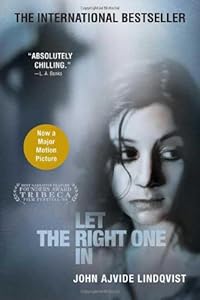
Cover of Let the Right One In: A NovelI have seen the film, Let the Right one in and that may shade my review. I have not seen the American version yet.
This was an excellent book. I enjoyed it a lot. It was read as part of a book club and everyone else liked it. That is pretty rare that a book gets universal acclaim at this book club. The characters are complex and the story is great.
This book is about a young boy (Oskar) that is picked on at school, doesn't have many friends, and is pretty lonely. That is until Eli moves into his building. He only sees her at night and she is super strange. She is a vampire. She doesn't want to eat Oskar, but only be his friend.
Sound heartwarming? Well, it isn't. The book is filled with enough murder and violence that it becomes clear that these two have become attached as a sort of survival mechanism.
Viewers of the Swedish film, like myself, had one major part of the book left out to us. That being Eli's origin story and the revelation that leads to for Oskar. That said, the Swedish film does a really good job and nailed the casting on both Oskar and Eli.
Thematically the book seems to be about friendship, parent child relationships, bullying, and pedephilia. The setting of early 80s Sweden is very affective as it is almost devoid of hope. You and up rooting for Eli, a character that lives off of the blood of others, unsympathetically.
I can see why this novel has spawned two movies and is an international best seller. It was excellent. The only draw back for me was the pacing was a little slow at points, but that may have been due to me seeing the film first and looking for certain things to happen.
I would recommend this to anyone who is looking for a good book to read. Violence and sexuality would limit it to more mature readers. You do not have to be a fan of vampires to enjoy this, but you may need a strong stomach.
Labels:
book review,
books,
let me in,
let the right one in
Thursday, January 06, 2011
Book Review: "Doomsday Book" by Connie Willis
I’ve occasionally heard the science fiction writing of Ray Bradbury be labeled as “soft” – in that his stories might take place in the future or have aliens, but that he doesn’t spend a lot of expositional effort on how we (or “they” for that matter) got there. He won’t discuss the propulsion system of a spaceship; letting us assume that it has one and that it’s good enough to get the characters where they’re going. The technology isn’t the thing.
Connie Willis’ wonderful time-travel novel “Doomsday Book” follows this same premise, taking place at Oxford University in the year 2055 – a time when historians can travel back into time to make observations of the past. Willis doesn’t go into space-time physics, but just lets us go with it.
In the story, a young historian, Kivrin Engle, is being sent back to observe the early 14th century – a trip further back in time than has ever been attempted before. There is decided departmental politics played out whether this is a good idea and if/how it should proceed. The book follows – if you will – two time streams: Kivrin in the 14th century and her mentor Dunleavy in present-time Oxford.

I had read Willis’ “To Say Nothing of the Dog” a couple of years ago and liked it. It was another time-travel story that was part mystery and part comedy-of-manners. This book was neither of those. It was, however, gripping– a story that drew you into the characters and both intertwined time lines as lives hung in the balance across the centuries. There are several gut-punches along the way that made it clear that all the loose-ends weren’t necessarily going to be put together tidily. The book won both the Hugo and Nebula Awards for 1992, and I can see why.
In fact, I think the only ding I have is that Willis’ decades-hence future missed two elements that were right on the cusp of introduction when “Doomsday Book” was published: cell phones and the internet. In several situations, Dunleavy and his colleagues are thwarted because they can’t get a call through on a land-line or can’t get to “the” computer in the lab. Each time I got one of these places in the story, I wrinkled my nose a little because Willis' “future” missed such an important technology and so required more suspension of my disbelief: not for time-traveling historians but for a world without smart phones.
Four out of five stars.
Labels:
book review,
books,
connie willis,
doomsday book,
science fiction
Subscribe to:
Posts (Atom)